The evolution of Godfrey

Work on the third issue of Folly Ground continues at a glacial pace. However, it is nice to spend some concentrated time on it during the festive season and away from the daily 09:00-17:00. If all goes well, some new pages will be ready by the end of next week. Here’s hoping!
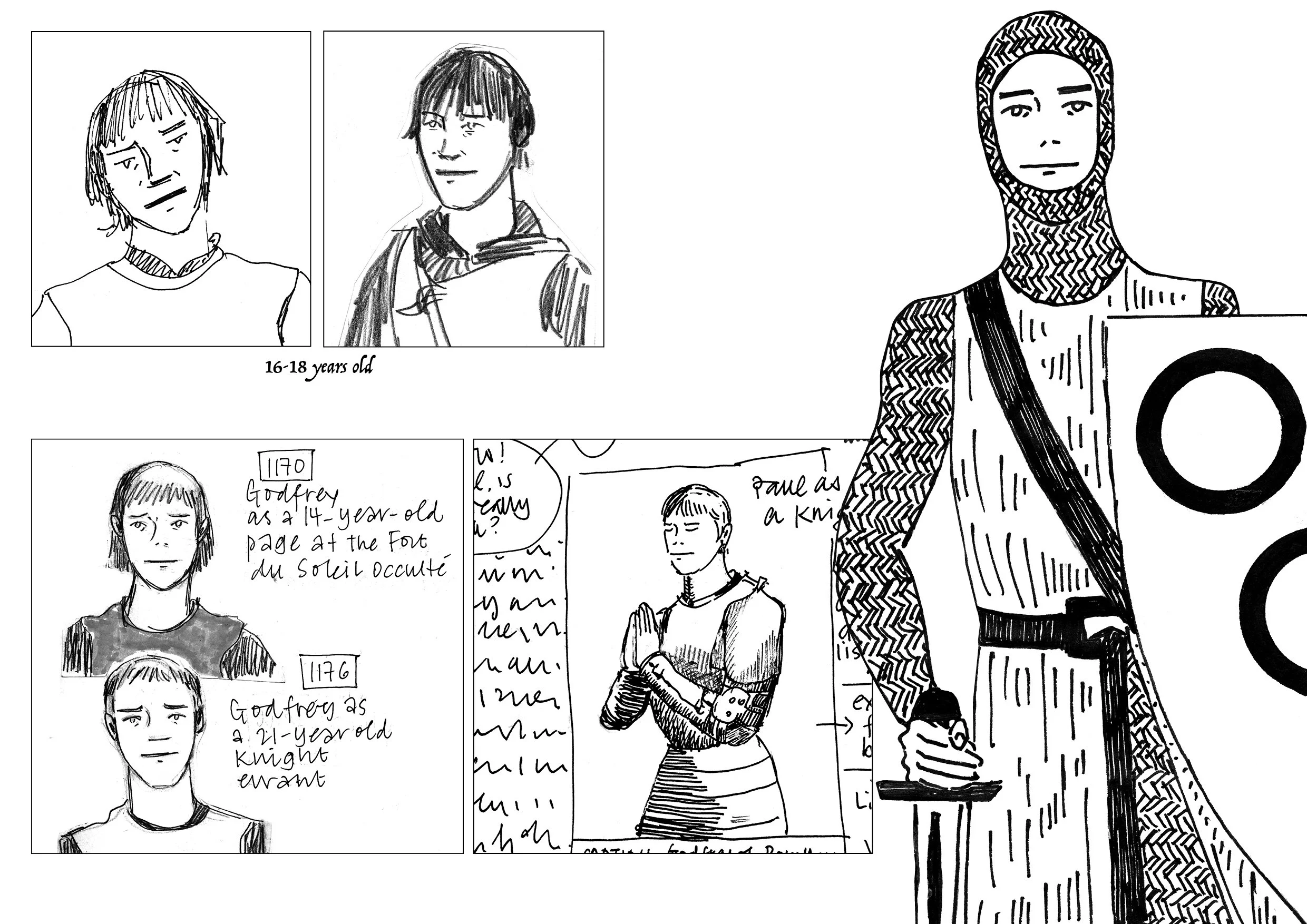
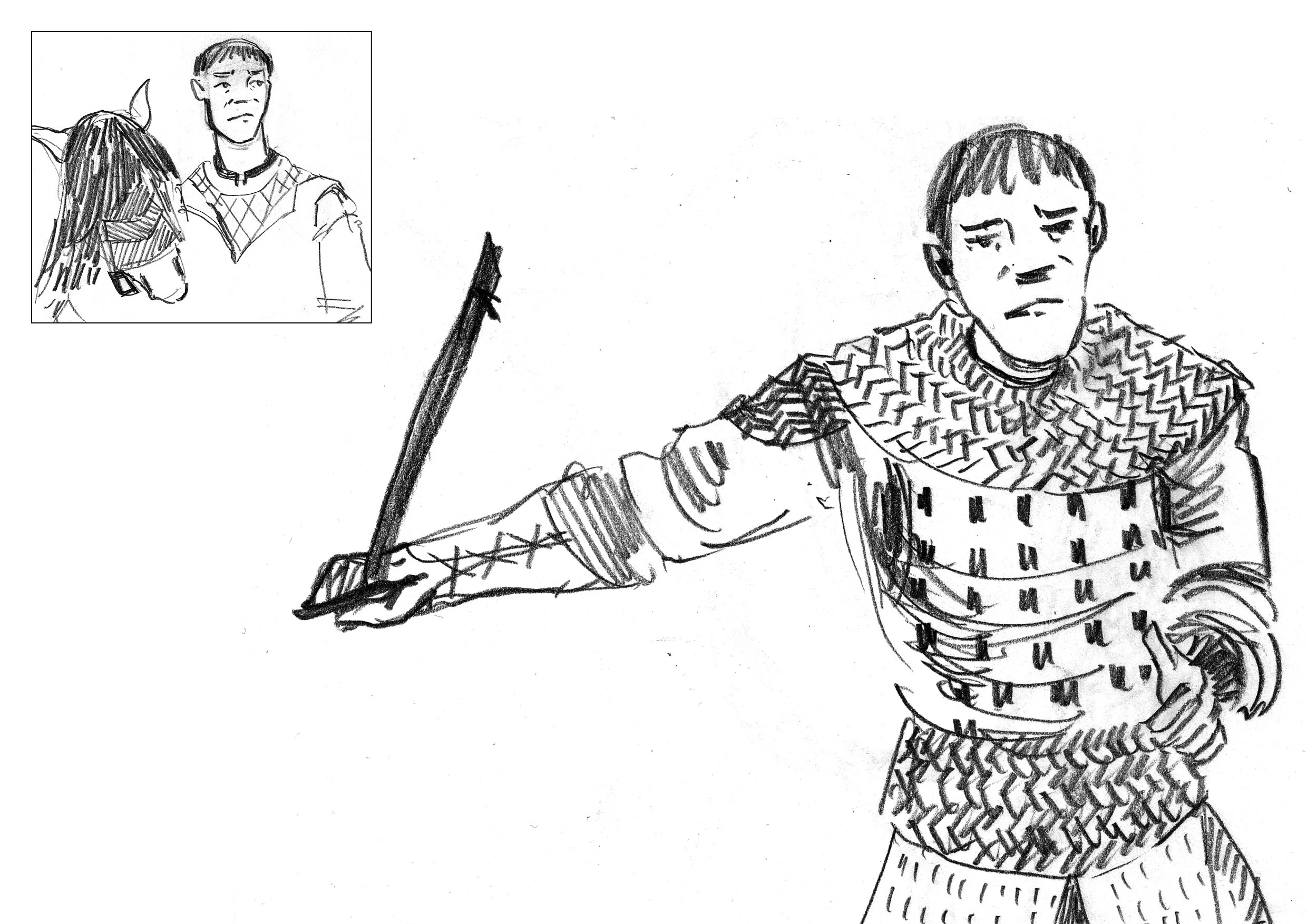
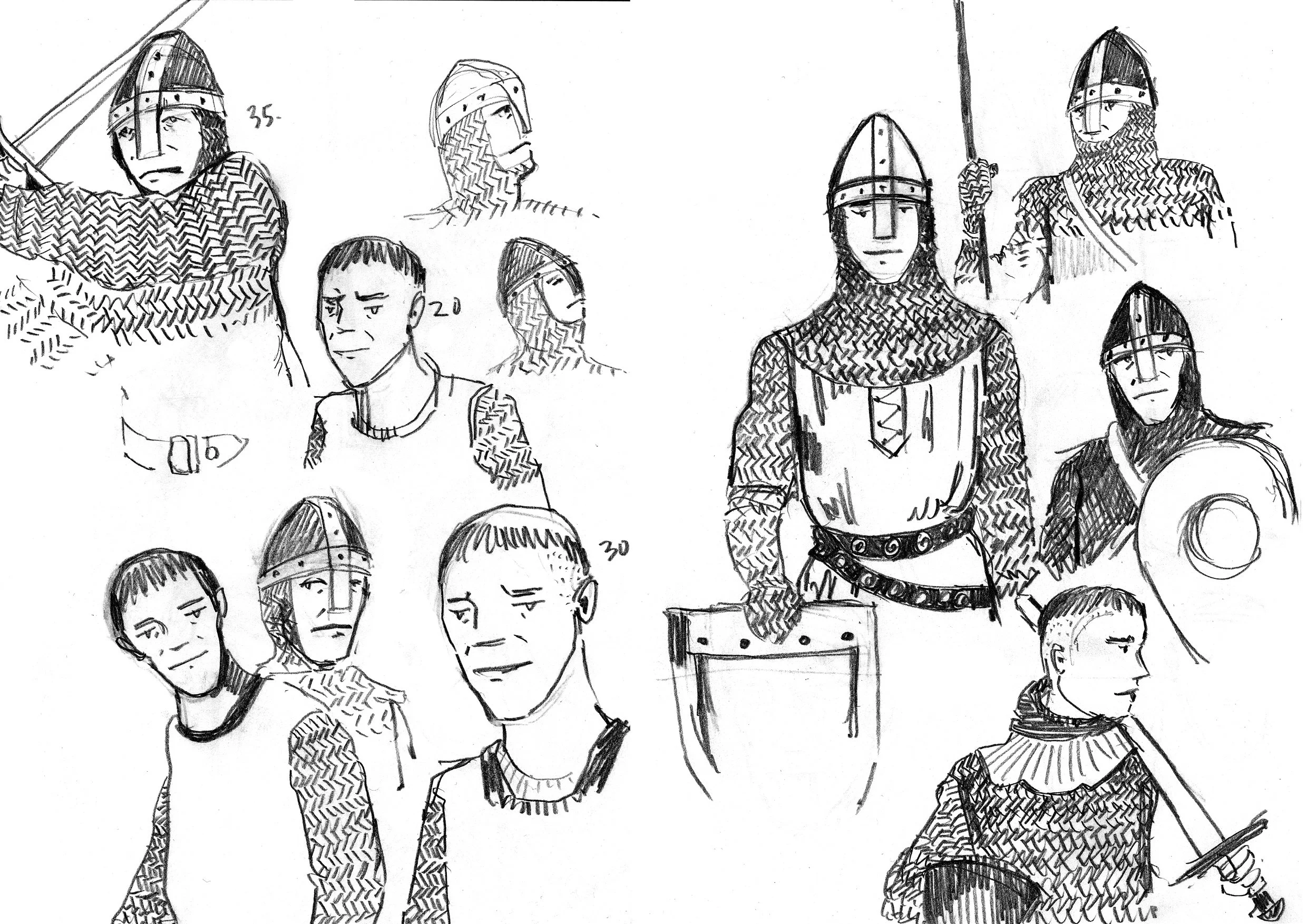
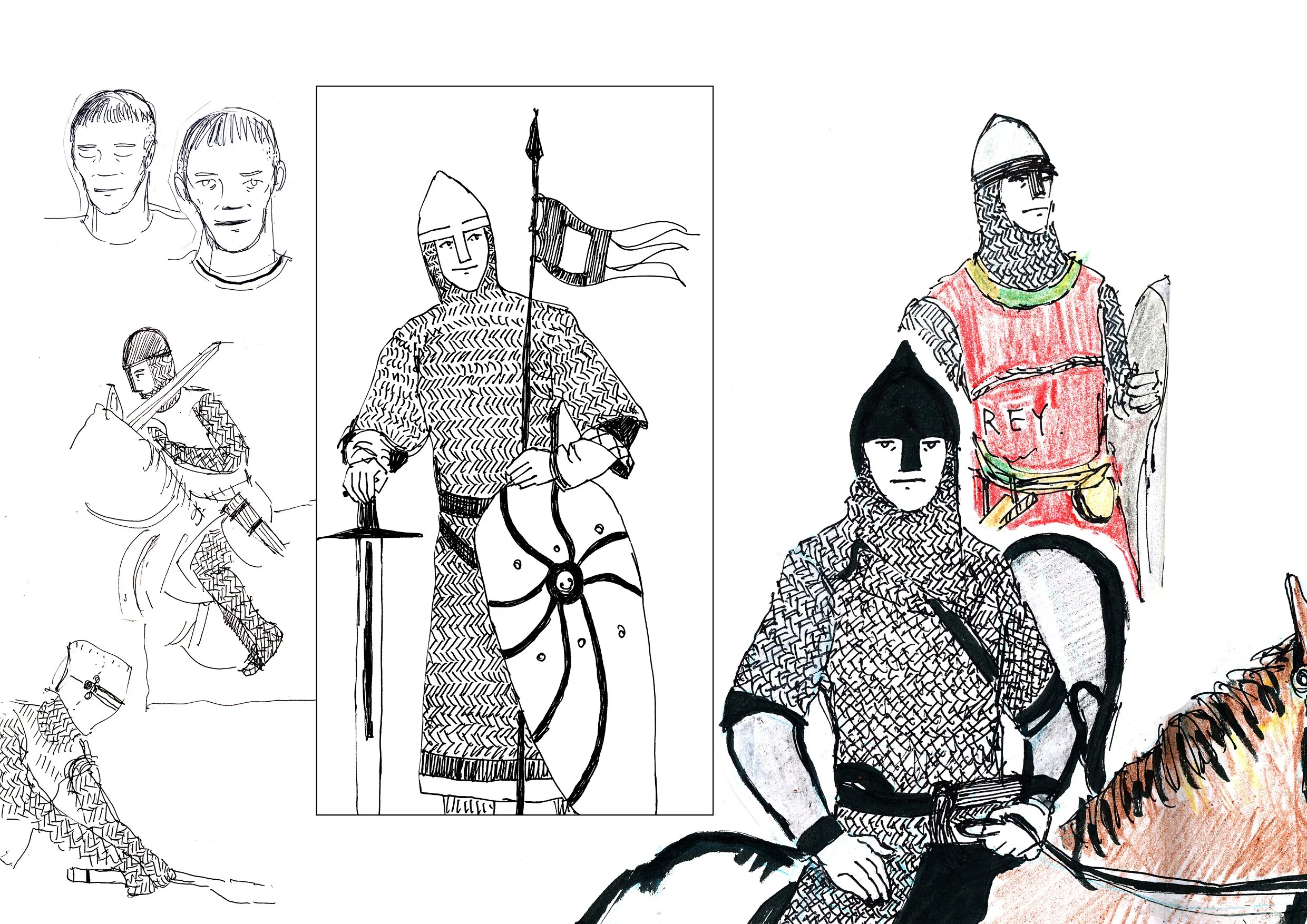
Above are some preparatory worksheets showing the (design) evolution of Godfrey the Wanderer, the character around whom the story of the third issue revolves. He is a figure of fascination for young Paul who thinks he may be related to him (see below). You may have caught glimpses of him in previous blog posts (see 3 January and 13 September 2025 and 24 June and 7 July 2024).
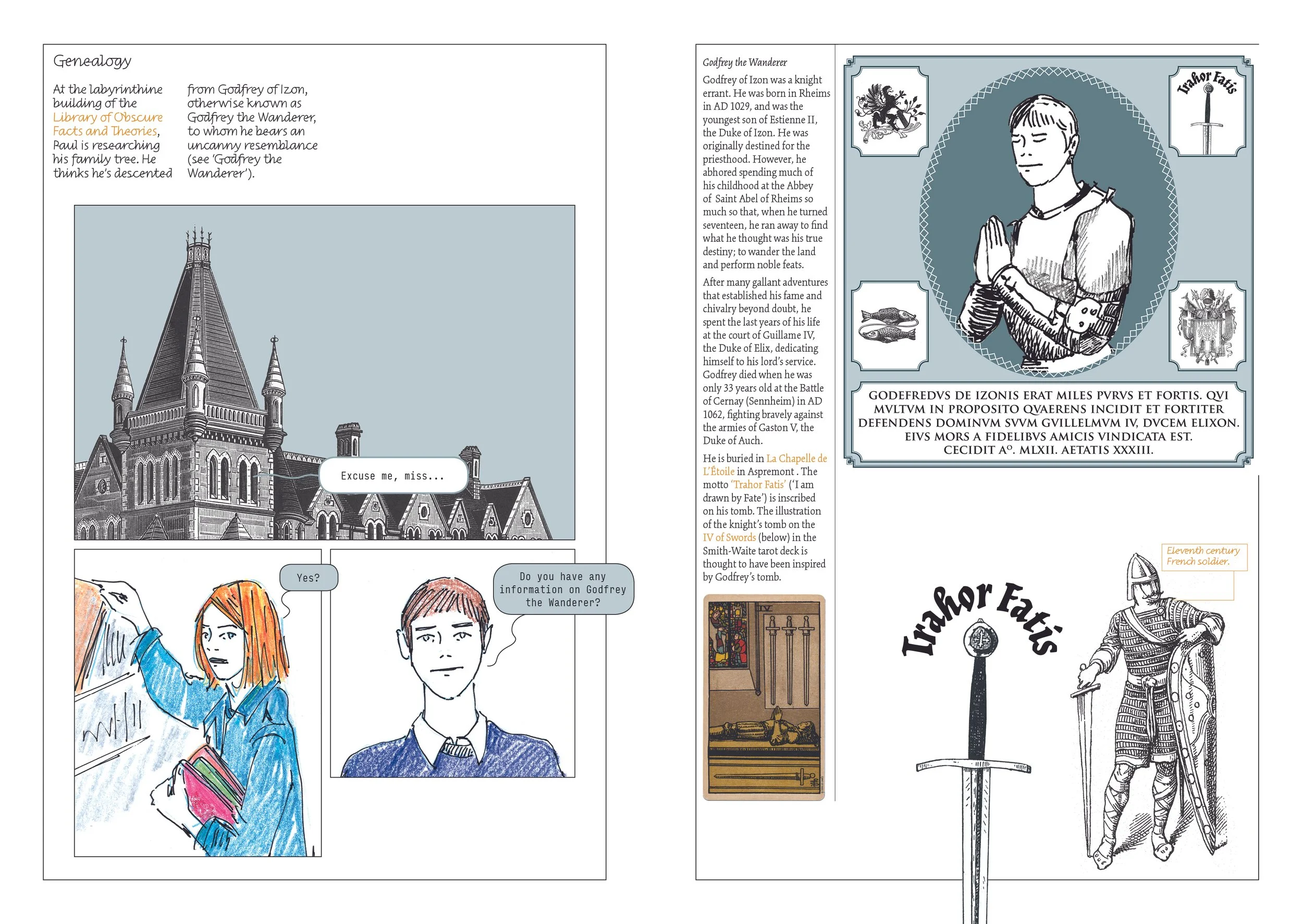
Here is some preliminary biographical information to go with the worksheets:

Godfrey of Izon (born c. 1156 – died 5 June 1198, Valenmont, France) was a Norman soldier, crusader, and captain of Guillaume IV’s militia. He was born at the Château des Nuages Dispersés (Castle of Scattering Clouds) in Izon, Normandy, and was the third son of Estienne II, Count of Izon and Ida of Rheims, daughter of William Devereux, Duke of St. Clair-Fort. Teasingly called ‘Godfrey The Wanderer’ due to his restlessness and liking for the peripatetic life, Godfrey was knighted in 1174 and spent his younger years as a knight-errant and a successful tournament competitor. Although information about Godfrey’s life is incomplete, his life was subsequently embellished in Medieval and Renaissance literature, the most well-known of which is the 13th century epic Chanson de Godfroi narrating his famously mystical encounter with The Hanged Man (he of Tarot fame). He died on the 5th of June 1198 by an arrow whilst laying siege to the Forteresse de l’ Abattement (Fortress of Dejection) in Valenmont, and was buried in La Chapelle de L’ Étoile (Chapel of The Star) in Aspremont.

All names and places above are of course entirely fictional, although the character and life of Godfrey is loosely based on William Marshal, 1st Earl of Pembroke, the famed 12th century Anglo-Norman knight; he served five English kings (Henry II, his sons Young Henry, Richard I, and John as well as John’s son, Henry III) as royal adviser, agent and as a soldier of outstanding prowess. His tomb can be visited at the Temple Church* in London.

Follow-up posts on the development of the third issue to come soon-ish.

*Temple Church was built by the Knights Templar for their English headquarters and consecrated on 10 February 1185.

Lox Retroversus

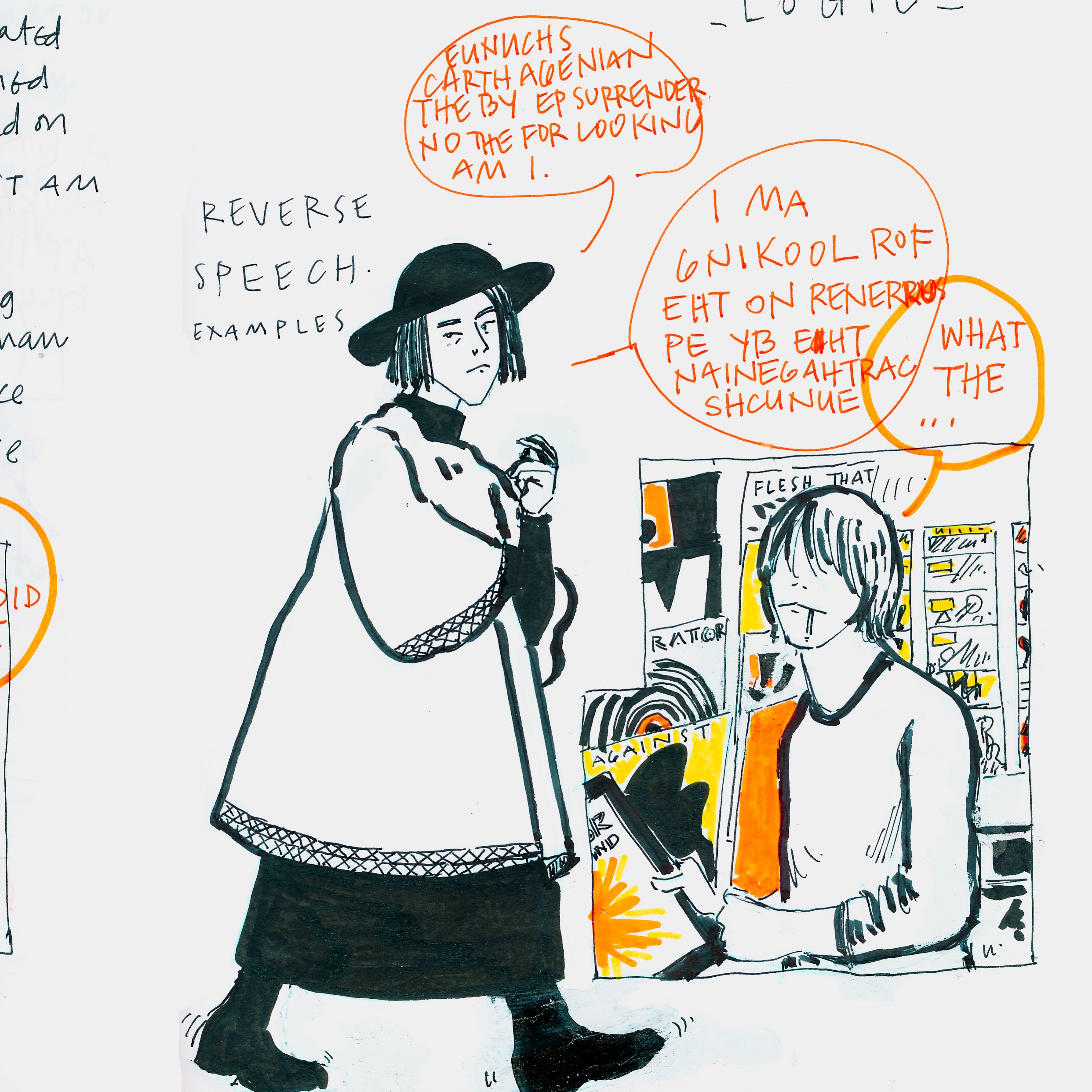
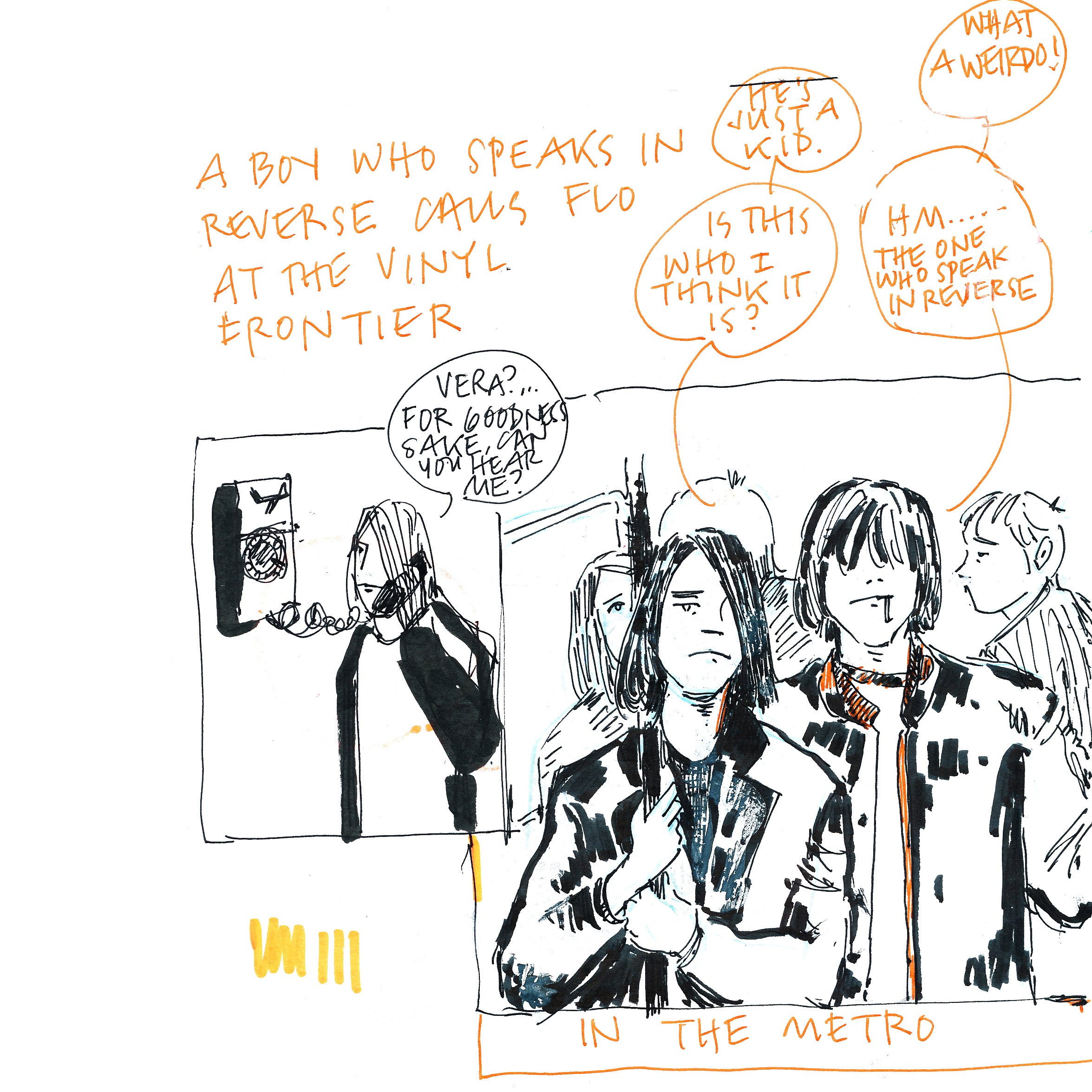
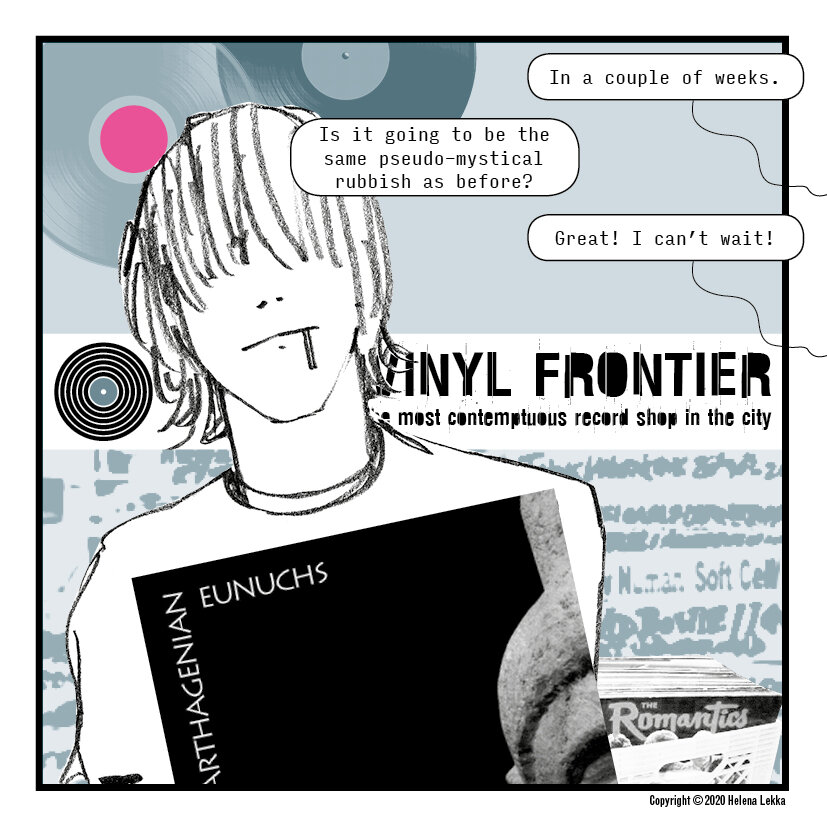
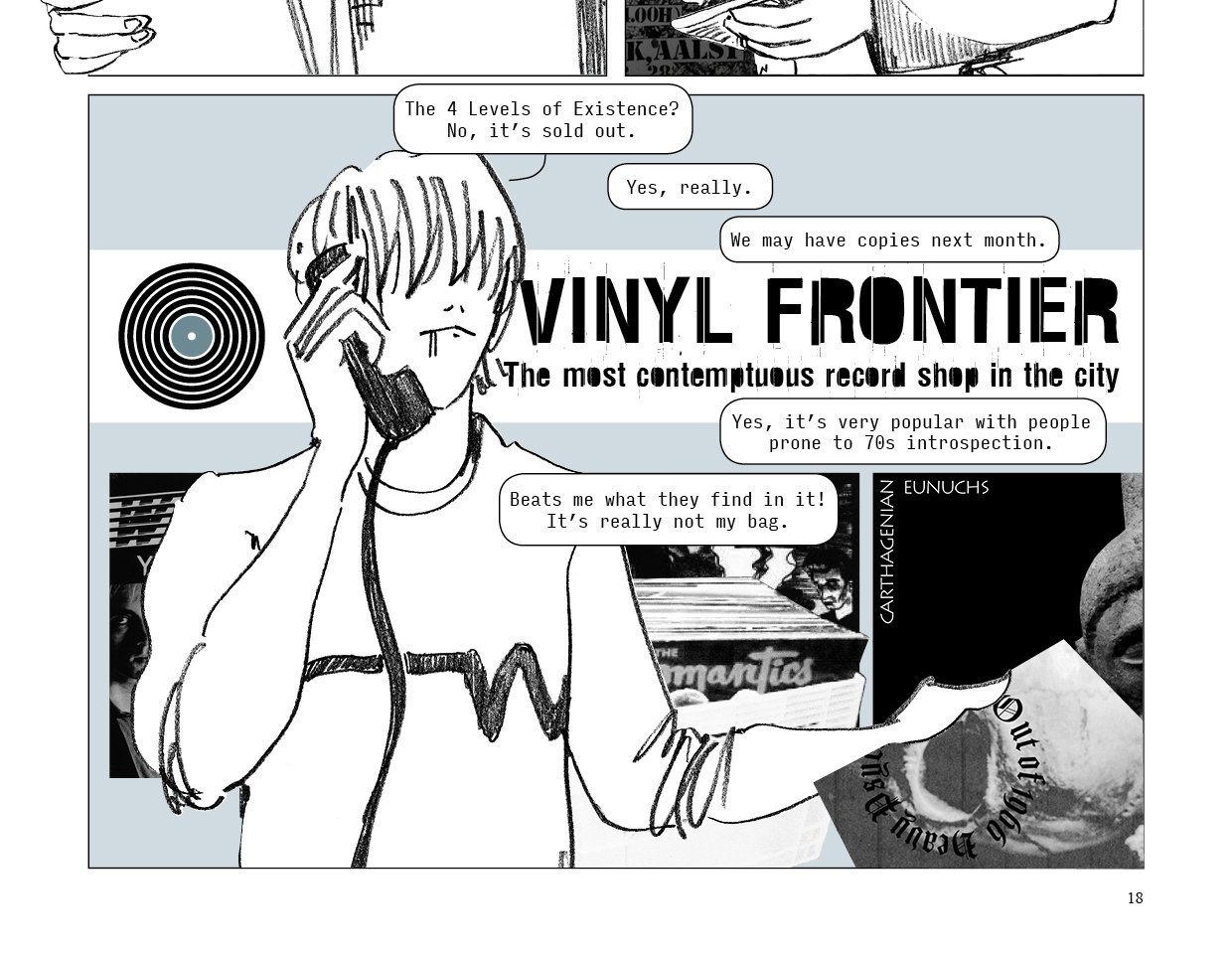
I am developing two new characters, both of whom I hope to introduce in the next issue of Folly Ground. This first one is Lox Retroversus, an absurdly young and precocious seminarian, with a strange affliction: he speaks backwards or in reverse (I haven’t quite worked that one out yet) during Mercury Retrograde periods*. Amazingly, he is a huge fan of the Carthaginian Eunuchs, an avant noise rock band famous for their on-stage antics – and Flo’s absolute favourite (For a detailed review, see 1 April 2023 post). Lox first comes into view during one of those aforementioned retrograde periods when he walks into the Vinyl Frontier looking for the Eunuchs’ latest EP, and his enthusiastic but incomprehensible speech causes considerable bafflement to the usually unflappable Flo.

Above: Initial character design and description.

Initially, I was looking for a name fit for a seminarian , i.e. one with a definite Greek or Latin flavour, such as Dominic or Gregory or even Clement. In the end, I opted for something slightly different: Lox refers to λοξός (loxós), a Greek word with a few meanings depending on the context it is used in. Mostly, λοξός refers to something oblique, not straight. It can also be used as an (not very flattering) adjective to describe someone, for example a peculiar or unreasonable person, sometimes even a crackpot. In this instance I mean Lox simply to be a pleasantly idiosyncratic, distinctive or slightly unusual teenage boy whose name mirrors his backward/reverse speech. ‘Retroversus’ is obviously from the verb ‘to retroverse’ meaning ‘to turn or tilt backwards’.

Above: Flo at the Vinyl Frontier. Excerpt from the first issue of Folly Ground.

As an aside, the designation ‘Λοξίας’ (Loxías) was an ancient religious invocation of the god Apollo that referred to the ambiguous prophecies originating at his Oracle at Delphi. Moreover,  Apollo was the god of light and directly associated with the sun, whose apparent path in the sky was considered oblique by the Greeks. Finally, a connection has also been made between the Greek ‘λοξίας’ and the Latin ‘lux’ meaning ‘light’.

More on Lox and the second character I am developing on follow-up posts soon.

*Mercury Retrograde is an optical illusion that occurs three to four times a year. The planet Mercury appears to travel backwards across the sky from the vantage point of Earth. In astrology these times are traditionally associated with confusion, delays and frustration, such as undelivered mail, miscommunication and frazzled travel plans. However, these periods are also considered to be excellent for reflecting on the past, intuition is thought to be high and coincidences are meant to be quite extraordinary.

SN 1181

Continuing on from the last post, this is still very much work in progress. Ideas from the last two posts are continuing to develop, albeit slowly. Some (very) broad themes I am working around include: ancestry, knights and chivalry, the Middle Ages, and astronomy.

A few notes that inform the image above: between 4-6 August 1181, the supernova* that has come to be known as SN 1181 was first observed in the sky by Chinese and Japanese astronomers, who recorded it in eight different texts. They described it as a ‘guest star’ (i.e. transient) that shone as bright as the planet Saturn. SN 1181 appeared in the constellation of Cassiopeia**, and was visible and motionless against the fixed stars for 185 days. Unfortunately, there are no known European sources on the appearance of such an event, even though people in Medieval Europe regulated their lives based on the position of the luminaries, the planets and the stars that constitute the signs of the zodiac.

At the same time, 1181 is the year when the first Franciscan orders emerged, and the Third Crusade (1189-1192) was a but a few years away.

*A supernova is the powerful and luminous explosion of a star in its last evolutionary stages.

**Cassiopeia is visible all year round, but can be found high in the sky from October to January.

Armies of the Astral Plane

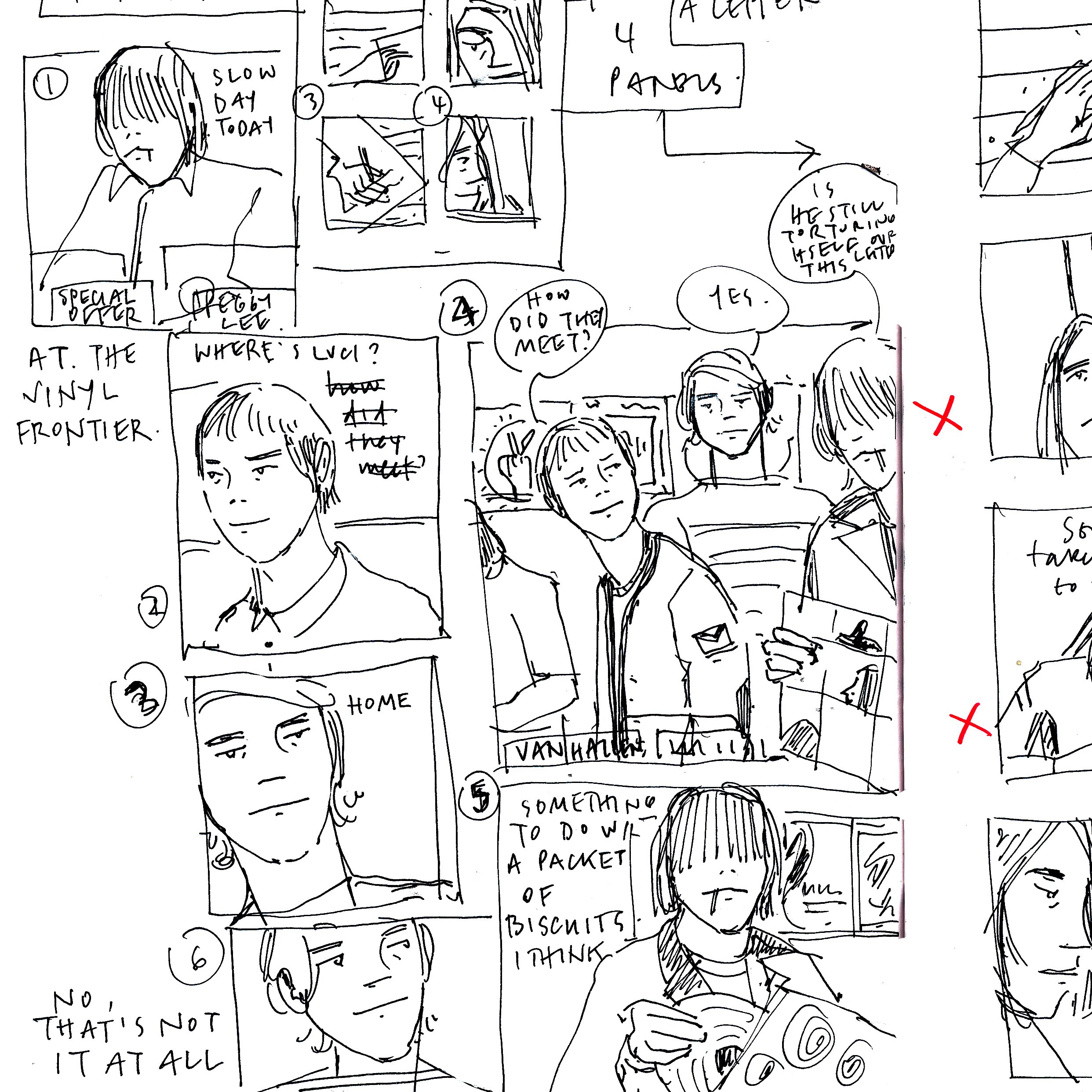
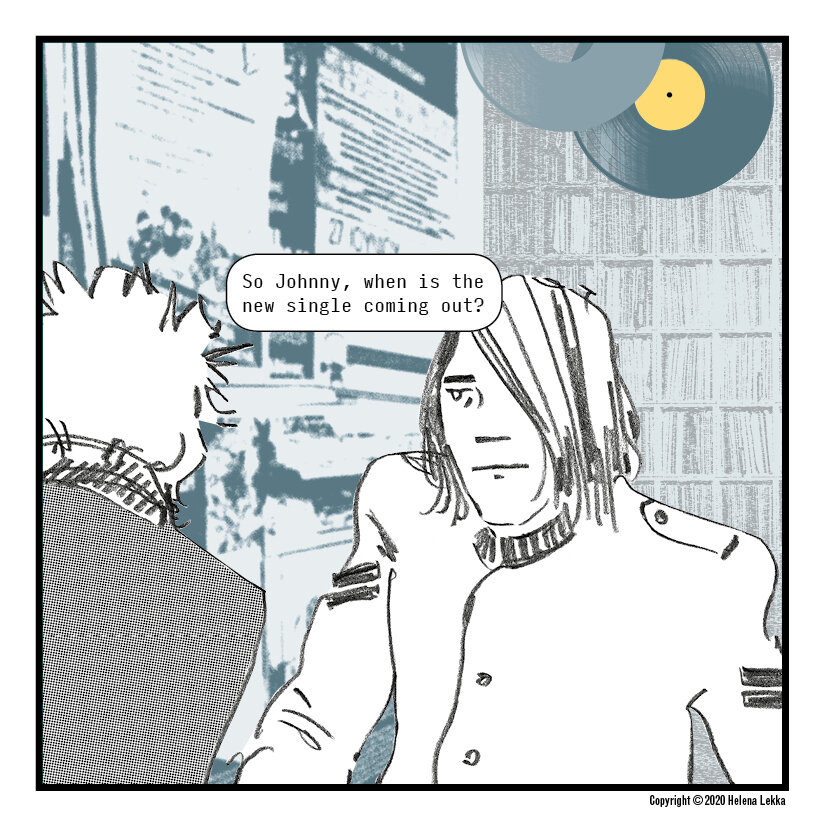
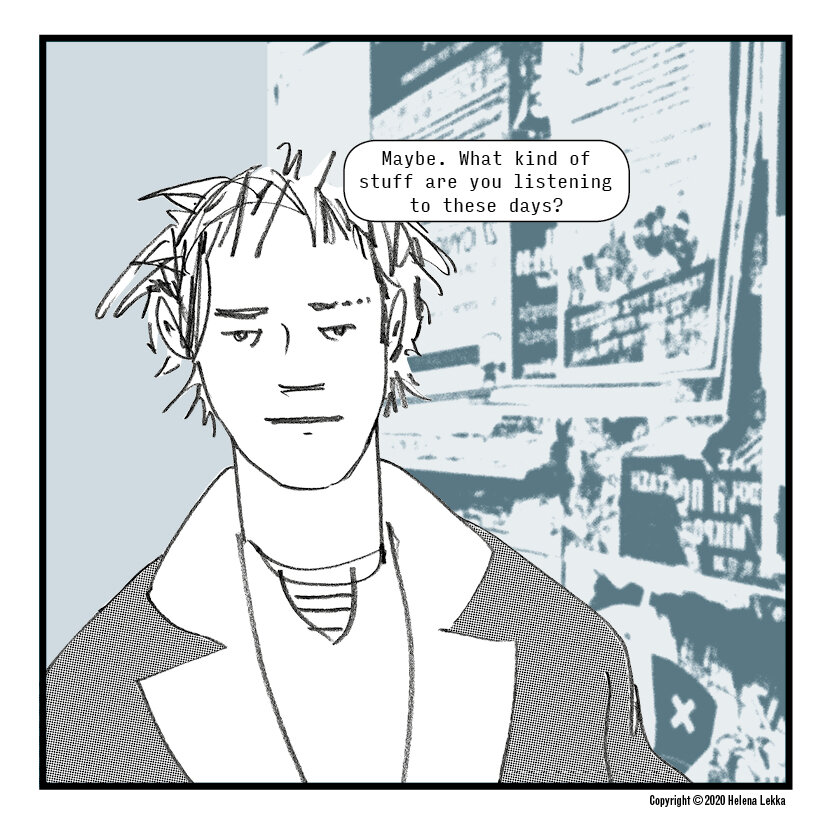
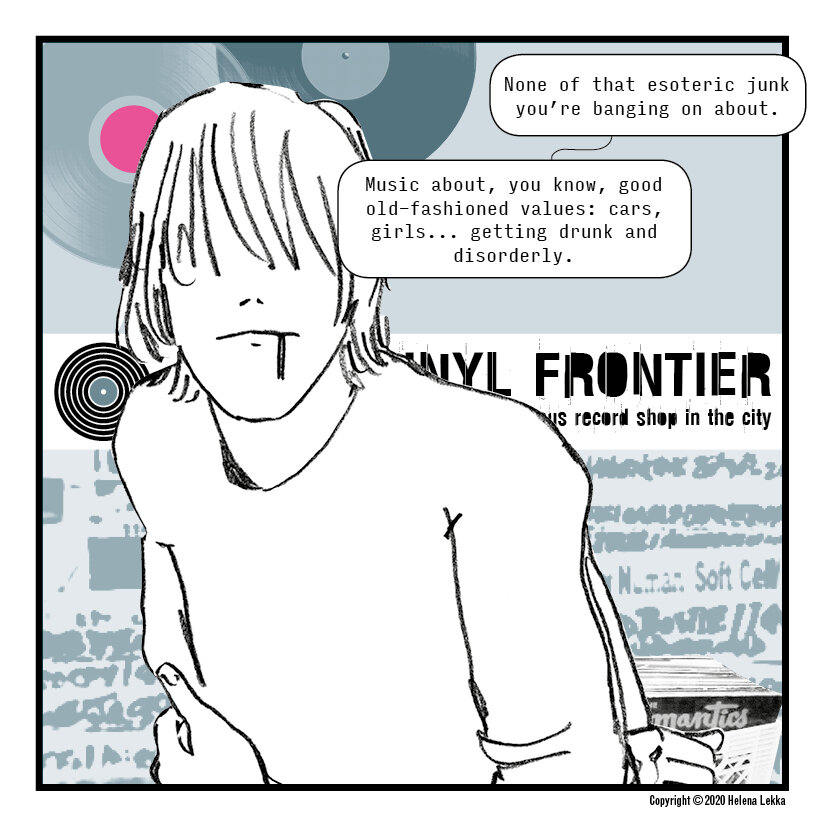
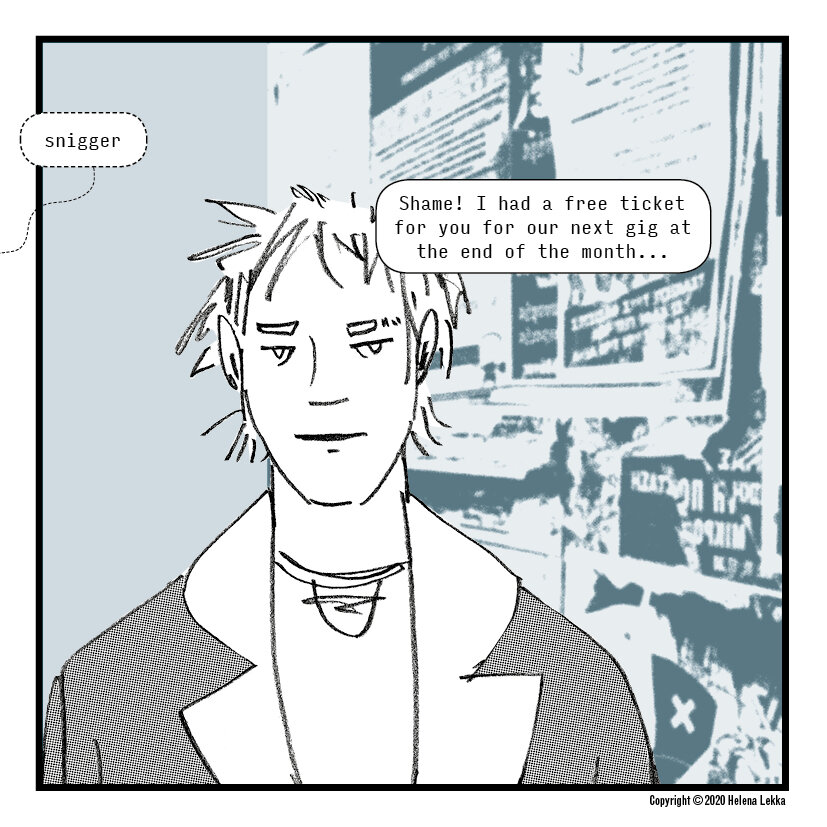
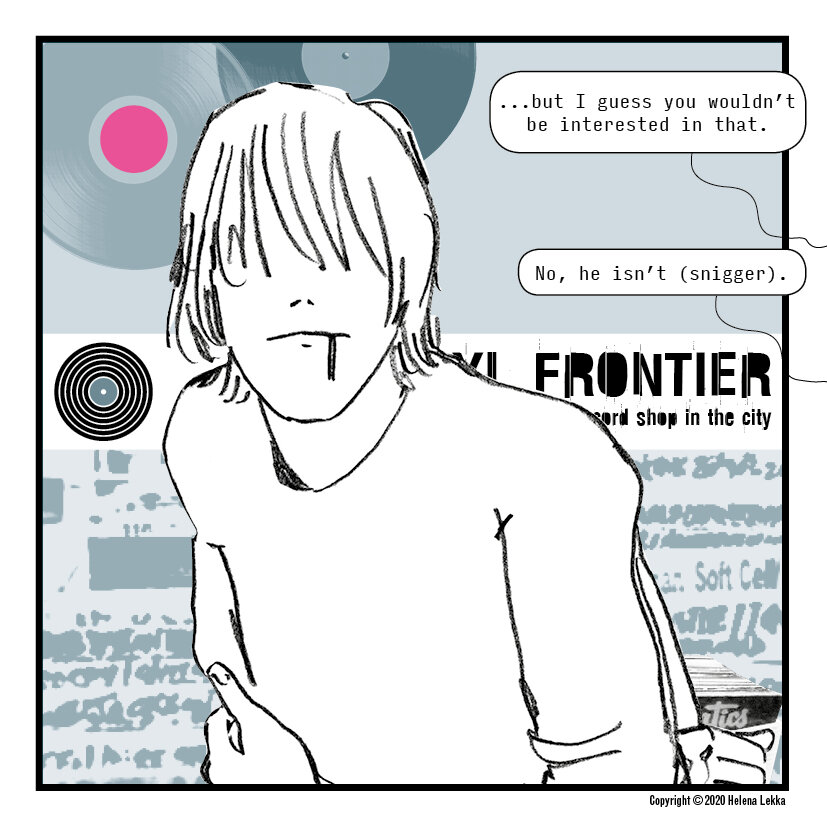
The panels below are work in progress for the second issue of Folly Gound, which is slowly taking shape. The setting is the ‘Vinyl Frontier’, the most contemptuous record shop in Folly Ground, and Flo’s workplace. The staff there have very definite opinions as to what constitutes good music and what doesn’t. This latest vignette is such an example, and involves Flo, Luci, and Luci’s friend Johnny Pyro, singer and guitarist with the band ‘Armies of the Astral Plane’.

The Armies of the Astral Plane are one of Folly Ground’s favourite bands. They made an appearance in the first issue: a full-page advert for their single ‘Subtle Doctrine’ was featured (see below). Also, a press release from the Diocese of the Doom & Gloom Faith announced them as the house band at the ‘And the end shall come’ theological conference, organised by the Holy Moses Institute for Disenfranchised and Dislocated Priesthood (HMIDDP). The press release also included a quotation from Johnny.

Advert for the single ‘Subtle Doctrine’ by the Armies of the Astral Plane. Folly Ground #1, April 2020.

Advert for the single ‘Subtle Doctrine’ by the Armies of the Astral Plane. Folly Ground #1, April 2020.

The Armies of the Astral Plane have a heavy psychedelic sound accompanied by rather esoteric lyrics, which are very thoughtfully written by Johnny. Luci and Raf are friends as well as huge fans of the band, something that really annoys Flo; he much prefers the Carthagenean Eunuchs who have a very, very different sound (and who were also prominent in the first issue). But that’s a subject for another post.

If you want to be reminded of Folly Ground’s musical ‘rivalries’, you can still leaf through the first issue. Just hit ‘Home’ in the menu above.

Also, if you care to comment, the comments section below is open for the next few days. It’s always helpful, and much appreciated, to get personal impressions from time to time. Or you can just say hello! Alternatively, if you know of anyone who you think may enjoy the world of Folly Ground, please feel free to spread the word, or use the ‘share’ button below to do so. Word-of-mouth is always the best recommendation, and I am very grateful for every visitor who takes an interest in this blog in these especially bleak times.